
 Physiotherapy for Knee Pain
Why Does Your Knee Hurt While Climbing Stairs?
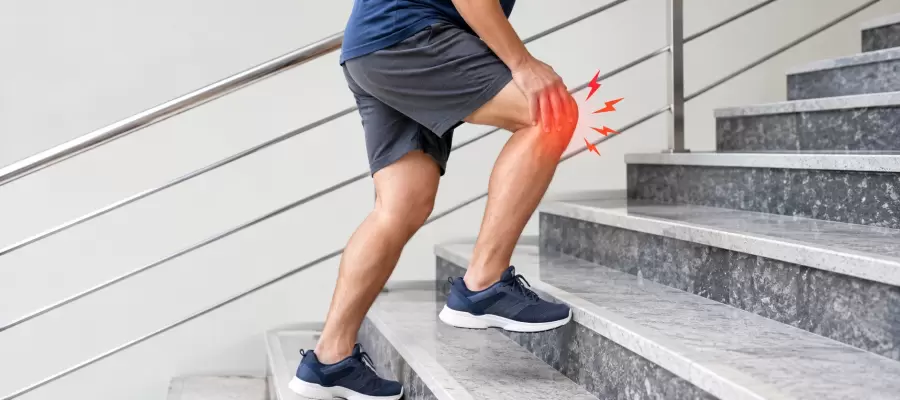
Whether you are in your early 20s navigating office stairwells, an active runner in your 30s, or an older adult keeping up with daily household activities, stair climbing should feel smooth and painless. Yet, for millions of people, taking that upward step triggers a sharp tweak, an aching burn, or an unsettling popping sound right under the kneecap.
Knee pain on stairs is one of the most common complaints brought to physical therapy clinics. The knee joint bears up to 3.5 to 4 times your total body weight every time you climb a single step. When structural alignment, joint flexibility, or muscle strength drops even slightly, that huge force concentrates directly on vulnerable cartilage and tendons.
What Causes Knee Pain While Walking Up and Down Stairs?
To understand why your knee hurts, it helps to look at how the joint operates under heavy loads. The biomechanics of stair climbing place distinct demands on your kneecap (patella), cartilage, and surrounding leg muscles.
1. Patellofemoral Pain Syndrome (Runner’s Knee)
Often nicknamed "Runner's Knee," this condition occurs when the patella does not track smoothly within the groove of the thigh bone (femur). Imbalances between the inner and outer quadriceps cause the kneecap to rub against bone, creating a dull, aching front-knee pain when bending under load.
2. Patellar Tendonitis & Ligament Strain
Repetitive stress from running, jumping, or sudden increases in daily physical activity can inflame the patellar tendon, which connects your kneecap to your shinbone. Climbing stairs pulls directly on this inflamed tissue, causing sharp front knee discomfort.
3. Meniscus Tear & Cartilage Wear
The meniscus acts as the natural shock absorber inside your knee. A minor tear or gradual wear can cause sharp pain, locking, or a catching sensation, especially when pivoting or stepping up onto higher elevated steps.
4. Knee Osteoarthritis & Wear and Tear
In middle-aged and older adults, the protective articular cartilage wears down over time, leading to bone-on-bone friction. This causes morning joint stiffness, swelling, and deep aching pain when negotiating staircases or rising from low seats.
How Specialized Physical Therapy Delivers Lasting Relief
Masking knee pain with temporary painkillers or resting continuously only hides the underlying structural issue. Long-term recovery requires targeted clinical interventions designed to restore biomechanics, relieve pressure, and build long-term tissue resilience.
Targeted Musculoskeletal Physiotherapy
Comprehensive Musculoskeletal Physiotherapy focuses on restoring normal joint mechanics and alignment. By correcting hip stability, foot pronation, and spinal posture, therapists reduce abnormal force and friction on the knee joint.
Advanced Manual Therapy & Soft Tissue Release
Hands-on Manual Therapy, gentle joint mobilizations, and Myofascial Release MFR relieve tight quadriceps and hamstrings, reduce joint pressure, and improve fluid circulation inside the knee capsule for fast mobility gains.
Clinical Strength Training & Functional Rehabilitation
Weak quadriceps, glutes, and core muscles force the knee joint to absorb excessive stress. A structured Strength Training program targets muscle imbalances, stabilizes kneecap tracking, and reinforces the soft tissues surrounding the joint.
Shockwave Therapy & Regenerative Treatments
For persistent tendon pain, heel spurs, or chronic joint inflammation, high-intensity modalities like Shockwave Therapy accelerate tissue regeneration, break down scar tissue, and boost collagen production without invasive procedures.
Personalized Rehabilitation Services at Sai Physiotherapy & Pain Management Clinic
At Sai Physiotherapy & Pain Management Clinic, treatment begins with finding the root cause of movement dysfunction rather than treating symptoms alone. Backed by 19+ years of extensive clinical experience and over 100,000 successful patient outcomes, our team provides evidence-based recovery plans tailored to your specific lifestyle and recovery goals.
What We Offer:
- Sports Physiotherapy: Specialized care for athletic injuries, ACL and meniscus rehabilitation, and biomechanical retraining to help athletes and active individuals return to sports safely through Sports Physiotherapy.
- Geriatric Physical Therapy: Targeted treatment for age-related arthritis, osteoporosis, balance disorders, and fall prevention to keep seniors moving independently with Geriatric Physical Therapy.
- Pre Post Surgery Rehabilitation: Comprehensive prehabilitation and post-operative care for total knee replacement (TKR), knee arthroscopy, and ligament repairs through Pre Post Surgery Rehabilitation.
- Home Physiotherapy: Specialized on-site clinical care for elderly patients, bedridden individuals, or those recovering from severe injuries who cannot travel to the clinic through Home Physiotherapy.
Why Do People Choose Sai Physiotherapy and Pain Management Clinic?
Finding trusted rehabilitation care near you makes all the difference in your recovery speed and overall well-being.
- 19+ Years of Experienced Clinical Practice: Led by a highly accomplished Consultant Neuro & Ortho Physiotherapist (BPT, MIAP) with nearly two decades of clinical expertise across government hospitals, multi-specialty centers, and private practice.
- 100,000+ Patients Treated: A proven track record of helping patients regain mobility, manage chronic pain, and avoid unnecessary surgeries.
- Cutting-Edge Technology and Modalities: Equipped with advanced evidence-based therapies such as Class IV Laser Therapy, Shockwave Therapy, SWD, and Spinal Decompression.
- We Served all Dwarka Sec: We provide accessible, high-quality care across all sectors in Dwarka (including Sector 1, 6, 7, 10, 12, 13, 14, 18, 19, 21, 22, and 23) with both in-clinic visits and doorstep Home Physiotherapy options.
- Compassionate, Patient-Centered Approach: Every program is built on personalized assessment, clinical evidence, and genuine empathy to ensure you regain complete functional independence.
Frequently Asked Questions (FAQs)
Should I keep climbing stairs if my knee hurts?
If stair climbing causes mild discomfort, slow down and use the handrail while taking steps one at a time (leading up with your uninjured leg). However, if you experience sharp pain, popping, or sudden swelling, stop immediately and seek professional evaluation.
Is knee pain on stairs always a sign of arthritis?
No. While knee osteoarthritis is common in older adults, younger individuals frequently experience stair pain due to Patellofemoral Pain Syndrome, quad muscle weakness, poor footwear, or patellar tendinitis.
How long does it take to recover from stair-related knee pain?
With targeted Musculoskeletal Physiotherapy and structured Strength Training, many patients notice significant relief within 2 to 4 weeks. Chronic issues or post-surgical cases may take 8 to 12 weeks of guided rehabilitation.
Have a question about your condition?
Our consultant physiotherapist is here to help.